Monday, 5 December 2011

Choppertone, Wooden Ableton Jazz Controller, and Folk Music of the 21st Century: Video


“Folk music of the 21st Century” – radio broadcaster, jazz aficionado, and jazz-based Ableton Live instrumentalist / remix artist Nick Francis really sums up what this whole site is about. As he chops up jazz greats in Ableton, his mash-up music chops are as much musical analysis as they are performance. He walks through his controller moves in a pedagogical way, highlighting the meat of the jazz legends he puts into play. It’s a kind of digital transcription, transcribing re-imagined for Ableton’s colored blocks in place of.
Of course, you’ll only be able to reflect on this once you can take your eyes off that stunning wooden controller, which has the look of a decades-old instrument. Kraftwerk in their early days would have chuckled at the polished-wooden nostalgia, but here, it’s about care as much as memory – and Nick is a fan of Kraftwerk, DJ Shadow, and others. None other than Matt Moldover inspired all of this. (I look forward to catching up with Matt in California next month.)

Wednesday, 30 November 2011

This Weekend Activities

Freerange Is Fifteen with Isolee (Live) / Jimpster + More @ Corsica Studios, Saturday 3rd.


Line Up


ROOM 1: Freerange Records
Isolée (live)
Jimpster
Andre Lodemann
Matt Masters

ROOM 2: Delusions Of Grandeur
Session Victim (Live & DJ)
Craig Smith (6th Borough Project)
Norm De Plume
Franc Spangler


Time: 10pm – 6 am
Venue: Corsica Studios / 5 Elephant Road. London SE17 1LB
Cost: £10 / £13 / MOTD


BEAT PLAYERS - 1st Birthday Party


Line Up


MATT BANDY (Limestone Recordings)
NEIL PIERCE
SY SEZ
Special LIVE performance from MIKE PATTO on keys


PAUL "TROUBLE" ANDERSON
SHAUN SAMUEL (birthday set)
STEPHEN ADAMS


Time: 8pm -3:30am 
Venue: 89 Great Eastern Street, EC2A 3HX 
Cost:  £8

Tuesday, 29 November 2011

Getting Creative With Serato Scratch Live

We tend to focus a lot on Traktor in our controllerism articles because of its simpler and more flexible controller mapping capabilities, but there are a fair few hidden – or at least, subtly introduced – features that make controllerism in Scratch Live a lot of fun too. While many “Serato” djs may stick to the basic 1 +1 deck paradigm, there are now a lot of additional tools that allow for tinkering if you are so inclined. 
Serato appears to have made a conscious decision to make mapping MIDI controllers simple, and it is somewhat at the expense of power. For instance, mapping a MIDI control to more than one Scratch Live function isn’t possible… but to mitigate that, Serato have integrated the Super Knob and Ultra Knob concept. They’ve also made it impossible to map buttons to dials and vice versa, but their way of working provides a loose workaround for the effects you might want to achieve by performing such a thing.
Important! Before you start, go into the MIDI page of the setup window and create a new MIDI preset. After you’ve made changes, save. If you don’t do this, all your hard work will be lost when you quit. Not fun.

BUILT-IN SMARTS

Scratch Live’s effects sit somewhere between Traktor’s group and advanced modes, with two assignable banks of three effects that can each be expanded to show their advanced controls. So, whilst Scratch Live only has two banks maximum, each bank has three effects that are always highly configurable – here are some advanced tips for creating effects behaviours.
The super knob concept allows you to create relative relationships between an effect’s main dial and its advanced parameters. The ultra knob goes a step further and allows you to create the same relationships between the three main effect knobs and an ‘omni knob’ for each bank. Here’s how:
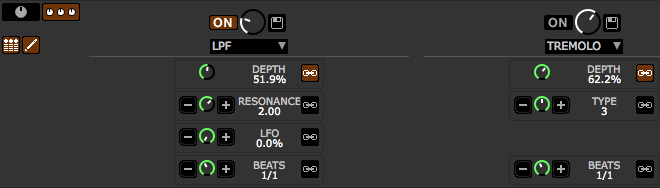
  1. Click the expand button (pictured) to show an effect’s advanced controls.
  2. Now, press the newly visible pencil button, which will open up the relationship controls.
  3. Move the dial to where you want it to be when the main dial is fully anticlockwise (‘off’) and press the ‘-‘ button.
  4. Now move the dial to where you want it to be when the main dial is fully clockwise (‘on’) and press the ‘+’ button.
  5. Make sure the link button is engaged.
Now when you turn the main dial, the advanced dials will turn the amount you’ve set up. If you set the controls to the opposite of the main dial – so that the advanced dial turns clockwise when the main dial turns anticlockwise – then the ring around the dial will be red instead of green.

PUSHING THE ENVELOPE

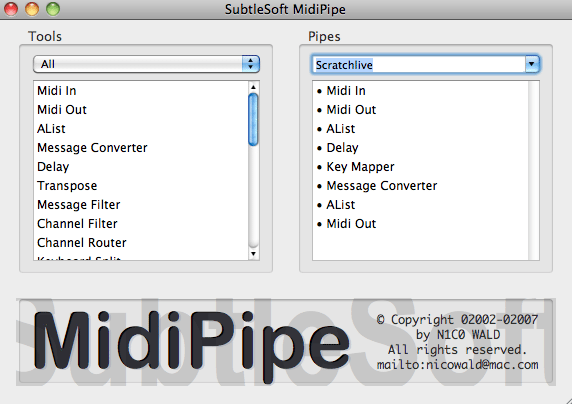
The super knobs and ultra knobs are obviously very powerful, but using Scratch Live’s native capability we’re limited to just one super knob per effect or one ultra knob per bank. If we use our MIDI intermediary software we can create as many as we like.
In testing, I learned two things about how Scratch Live treats MIDI input. Firstly, it’s got no issue with commands coming in simultaneously and so we don’t have to worry about creating delays between our message splitting. Secondly, it won’t learn the second in a string of MIDI commands even if you do put a delay in, so it’s necessary to build the MidiPipe template up with these steps:
  1. Set up a MIDI in in your MIDI software.
  2. Set up a MIDI out to go to ‘Scratch Live MIDI in’ in the software, and ensure that ‘pass through’ is enabled.
  3. ‘Learn’ the first command in Scratch Live.
  4. Add a message converter, change the CC of your control to something else (it’s a good idea to plan out what you’re doing to avoid a mess down the road) and put it after the first MIDI in in your MIDI software.
  5. Now that the control has been switched, go back to Scratch Live and learn the next command.
  6. Return to the MIDI software and move the message converter to the end of the pipe, adding another MIDI out after it.
  7. For extra controls, repeat from Step 4.

THE NON-EFFECT EFFECTS

Scratch Live doesn’t count censor or loop roll as effects – this means that they can be used without taking up a slot in your DJ-FX rack. Whilst that’s all good, it also means they can’t be hooked up to super or ultra knobs, and so if we want to use them to their full potential we need to get a little creative with MidiPipe or the equivalent.
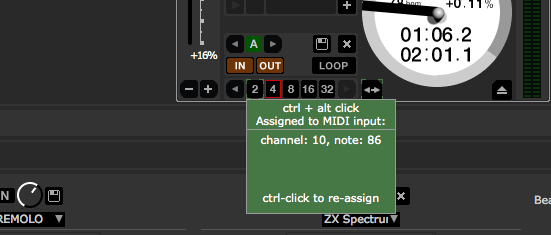
Here’s a trick that, whilst not super new, may have passed you by: instead of mapping a single loop roll button, you can map as many as you like to individual loop roll lengths by pressing ctrl+alt+click on the loop button in MIDI mode.
In a similar shortcut to the loop roll trick mentioned above, you can also ctrl+click on the effects activation buttons to turn them into momentary triggers. Try assigning loop roll activation and effects activation to the same button by creating a basic key mapper MIDI pipe and using these hidden momentary press controls for some very cool effects!
As a final note, because censor’s a button and Scratch Live doesn’t allow buttons to be triggered by specific values of CCs, we have to do some jiggery pokery in our MIDI software and turn our CC message into a note message. I use MidiPipe often because it’s very quick and easy to use, but when it gets to the more complicated actions, Bome’s Midi Translator Pro is the way to go. What we need to do is tell Midi Translator to turn only the final value on a single CC message (127, or 7F in hex) into a note on message, and also that the next one below (126, or 7E in hex) into a note off message. This will allow us to create a knob that can be assigned as we wish, but at the very end of its throw also sends things into reverse!

Monday, 28 November 2011

At One - African Healing Dance Comming Soon - 09/12/11

 At One - African Healing Dance (feat. Wyoma) Comming Soon -RELEASED 09/12/11 by Atjazz Record Company 


'African dance healing' is an awesome workout of percussion, beats, bass and vocals and is a wash with stylish & precise synth production. This latest outing for the UK’s ‘At One; is set for the main dance floor and is backed up by Wyoma’s beautiful words of wisdom, “Wyoma honors dance as a healing and spiritual endeavor”. This careful selection of lyrics really does make you think twice and make you wanna get up and use those feet you we’re given. African dance healing does what it says on the tin, already supported with incredible feedback by Atjazz. Accompanying this wonderful piece of writing is another well rounded piece of music entitled ‘Miti’, a straight down the line dance-floor bumper, with a twist on what people know as “Techy Afro House” ‘At One’ has really started for us a new direction in this genre & we are very proud to have this artist as part of the ARCo. family.
At One is a new age DJ/Producer with an old-skool kick, playing in and around the U.K's capital city London on a regular basis, mainly spinning deep/soulful/afro house. The music At One produces has an interesting twist to it’s overall sound, whatever genre it is. At One encompasses the best from every area within the genres he produces within and places these influences into his music whatever style his productions may be. The At One sound is neither old nor new but something in it’s own space which lasts the test of time.
Wyoma is a performer and facilitator of African and healing dance, as well as a body/mind consultant. For over twenty-three years she has taught and conducted workshops in a wide range of contexts throughout the United States. She has also worked in Africa and New Zealand. Central to her approach is the transformative and organic nature of African Dance, and the recognition of our body's own inherent wisdom. Wyoma honors dance as a healing and spiritual endeavor, and has become a creative force for transformation among her students, audiences, and associate performers.
Cedits:
Written by R. Ward & Wyoma
Produced by At One
Arranged by At One
Vocals by Wyoma
Published by (Copyright control 2011)
(c) & (p) Atjazz Record Company
Cover photography by Martin Iveson. Design by Subism.co.uk
Atjazz websites: www.atjazz.co.uk | www.atjazz.co.uk/label
Released by: Atjazz Record Company 
Release/catalogue number: ARC-035-SD
Release date: Dec 9, 2011

Thursday, 24 November 2011

Henrik Schwarz Video On Live Sets in Ableton

Producer Henrik Schwarz explains how he organizes his live sets in Ableton and how he programmed his Schwarzonator plugin. 

CDR is the platform for the airing of new ideas, works in progress, unreleased songs, remixes and edits in a sound-system oriented environment. Created on laptops, bedroom studios, sampling sequencers and digital multi-tracks, music producers can at last air their productions in a neutral space to a like-minded audience. CDR connects producers, labels, DJs and music lovers- simply for the love of music.


CDR Berlin Workshop HENRIK SCHWARZ (Innervisions) from CDR on Vimeo.

Wednesday, 23 November 2011

This Weekend Activities

Simmer 3rd Birthday present Kink & Neville Watson Live and Silicone Soul @ Basing House, Friday 25th.


Line Up


KiNK & Neville Watson LIVE (Poker Flat, Rush Hour)

Silicone Soul (Soma, Darkroom Dubs)
Richard Adam (Resident)

Time: 10pm - 4am
Venue: Basing House/ 25 Kingsland Road, Shoreditch, E28AA
Cost: £5 Earlybird / £8 / £10 / £12 OTD


Muak 8: A Private Birthday with Kerri Chandler @ TBA - London, Saturday 26th.


Line Up


Kerri Chandler
DJ Le Roi
Zaki
Manish
+ more TBA


Time: 10pm - 6am
Venue: TBA
Cost: £10, £13, £15, £20


Tuesday, 22 November 2011

Why does music make us feel? The Science


By Jonah Lehrer

Why does music make us feel? On the one hand, music is a purely abstract art form, devoid of language or explicit ideas. The stories it tells are all subtlety and subtext. And yet, even though music says little, it still manages to touch us deep, to tickle some universal nerves. When listening to our favorite songs, our body betrays all the symptoms of emotional arousal. The pupils in our eyes dilate, our pulse and blood pressure rise, the electrical conductance of our skin is lowered, and the cerebellum, a brain region associated with bodily movement, becomes strangely active. Blood is even re-directed to the muscles in our legs. (Some speculate that this is why we begin tapping our feet.) In other words, sound stirs us at our biological roots. As Schopenhauer wrote, “It is we ourselves who are tortured by the strings.”
We can now begin to understand where these feelings come from, why a mass of vibrating air hurtling through space can trigger such intense states of excitement. A brand new paper in Nature Neuroscience by a team of Montreal researchers marks an important step in revealing the precise underpinnings of “the potent pleasurable stimulus” that is music. Although the study involves plenty of fancy technology, including fMRI and ligand-based positron emission tomography (PET) scanning, the experiment itself was rather straightforward. After screening 217 individuals who responded to advertisements requesting people that experience “chills to instrumental music,” the scientists narrowed down the subject pool to ten. (These were the lucky few who most reliably got chills.) The scientists then asked the subjects to bring in their playlist of favorite songs – virtually every genre was represented, from techno to tango – and played them the music while their brain activity was monitored.
Because the scientists were combining methodologies (PET and fMRI) they were able to obtain an impressively precise portrait of music in the brain. The first thing they discovered (using ligand-based PET) is that music triggers the release of dopamine in both the dorsal and ventral striatum. This isn’t particularly surprising: these regions have long been associated with the response to pleasurable stimuli. It doesn’t matter if we’re having sex or snorting cocaine or listening to Kanye: These things fill us with bliss because they tickle these cells. Happiness begins here.
The more interesting finding emerged from a close study of the timing of this response, as the scientists looked to see what was happening in the seconds before the subjects got the chills. I won’t go into the precise neural correlates – let’s just say that you should thank your right NAcc the next time you listen to your favorite song – but want to instead focus on an interesting distinction observed in the experiment:
In essence, the scientists found that our favorite moments in the music were preceeded by a prolonged increase of activity in the caudate. They call this the “anticipatory phase” and argue that the purpose of this activity is to help us predict the arrival of our favorite part:
Immediately before the climax of emotional responses there was evidence for relatively greater dopamine activity in the caudate. This subregion of the striatum is interconnected with sensory, motor and associative regions of the brain and has been typically implicated in learning of stimulus-response associations and in mediating the reinforcing qualities of rewarding stimuli such as food.
In other words, the abstract pitches have become a primal reward cue, the cultural equivalent of a bell that makes us drool. Here is their summary:
The anticipatory phase, set off by temporal cues signaling that a potentially pleasurable auditory sequence is coming, can trigger expectations of euphoric emotional states and create a sense of wanting and reward prediction. This reward is entirely abstract and may involve such factors as suspended expectations and a sense of resolution. Indeed, composers and performers frequently take advantage of such phenomena, and manipulate emotional arousal by violating expectations in certain ways or by delaying the predicted outcome (for example, by inserting unexpected notes or slowing tempo) before the resolution to heighten the motivation for completion. The peak emotional response evoked by hearing the desired sequence would represent the consummatory or liking phase, representing fulfilled expectations and accurate reward prediction. We propose that each of these phases may involve dopamine release, but in different subcircuits of the striatum, which have different connectivity and functional roles.
The question, of course, is what all these dopamine neurons are up to. What aspects of music are they responding to? And why are they so active fifteen seconds before the acoustic climax? After all, we typically associate surges of dopamine with pleasure, with the processing of actual rewards. And yet, this cluster of cells in the caudate is most active when the chills have yet to arrive, when the melodic pattern is still unresolved.
One way to answer these questions is to zoom out, to look at the music and not the neuron. While music can often seem (at least to the outsider) like a labyrinth of intricate patterns – it’s art at its most mathematical – it turns out that the most important part of every song or symphony is when the patterns break down, when the sound becomes unpredictable. If the music is too obvious, it is annoyingly boring, like an alarm clock. (Numerous studies, after all, have demonstrated that dopamine neurons quickly adapt to predictable rewards. If we know what’s going to happen next, then we don’t get excited.) This is why composers introduce the tonic note in the beginning of the song and then studiously avoid it until the end. The longer we are denied the pattern we expect, the greater the emotional release when the pattern returns, safe and sound. That is when we get the chills.
To demonstrate this psychological principle, the musicologist Leonard Meyer, in his classic  bookEmotion and Meaning in Music (1956), analyzed the 5th movement of Beethoven’s String Quartet in C-sharp minor, Op. 131. Meyer wanted to show how music is defined by its flirtation with – but not submission to – our expectations of order. To prove his point, Meyer dissected fifty measures of Beethoven’s masterpiece, showing how Beethoven begins with the clear statement of a rhythmic and harmonic pattern and then, in an intricate tonal dance, carefully avoids repeating it. What Beethoven does instead is suggest variations of the pattern. He is its evasive shadow. If E major is the tonic, Beethoven will play incomplete versions of the E major chord, always careful to avoid its straight expression. He wants to preserve an element of uncertainty in his music, making our brains beg for the one chord he refuses to give us. Beethoven saves that chord for the end.
According to Meyer, it is the suspenseful tension of music (arising out of our unfulfilled expectations) that is the source of the music’s feeling. While earlier theories of music focused on the way a noise can refer to the real world of images and experiences (its “connotative” meaning), Meyer argued that the emotions we find in music come from the unfolding events of the music itself.  This “embodied meaning” arises from the patterns the symphony invokes and then ignores, from the ambiguity it creates inside its own form. “For the human mind,” Meyer writes, “such states of doubt and confusion are abhorrent. When confronted with them, the mind attempts to resolve them into clarity and certainty.” And so we wait, expectantly, for the resolution of E major, for Beethoven’s established pattern to be completed. This nervous anticipation, says Meyer, “is the whole raison d’etre of the passage, for its purpose is precisely to delay the cadence in the tonic.” The uncertainty makes the feeling – it is what triggers that surge of dopamine in the caudate, as we struggle to figure out what will happen next. And so our neurons search for the undulating order, trying to make sense of this flurry of pitches. We can predict some of the notes, but we can’t predict them all, and that is what keeps us listening, waiting expectantly for our reward, for the errant pattern to be completed. Music is a form whose meaning depends upon its violation.
Homepage image: Kashirin Nickolai, Flickr.