
Welcome To The Home Of Dj/Producer At One
Showing posts with label IOS. Show all posts
Showing posts with label IOS. Show all posts
Monday, 25 March 2013


Monday, 27 February 2012
iPad Drum Pad Controller: MidiPads
The iPad as a controller is at its best when it plays to its strengths, letting you use that continuous finger control do something useful. So that makes MidiPads worth a look. It’s a strikingly-versatile drum pad controller with all of the kinds of features you might want, and with a major version 1.5 release this week, looks even more useful as a control addition to your studio.
First off, it’s got all of the I/O you could want:
- USB MIDI (so, use the Camera Connection Kit and a class-compliant interface, or dedicated interfaces like iRig MIDI and MIDI Mobilizer II)
- Wireless MIDI over a WiFi connection
- Virtual MIDI, for connecting to other apps (we need to do a round-up of these soon, so give a shout if you have a moment, devs)
Once connected, MidiPads sets itself apart with flexible control on each of those pads. Just tapping rectangles isn’t much fun on the iPad, of course – you lack tactile feedback and pressure sensitivity found on a physical pad. So, instead, MidiPads provides other modulation to exploit the touchable surface for continuous control. In fact, thinking of it as a “drum pad” is almost a bit unfair. New in this release:
- Presets, which you can share with other users – which could in turn make a nice little community of users here
- “Bouncing mode” for touch pads and sliders
- Send multiple messages with each axis and knob
- Individual up/down messages for each touch pad and slider, if you so wish
- Enhanced views, settings reset, and MIDI connection settings
- Resize pads and pad area (essential for either fat fingers or getting more controls!)

What I like best of all is the integration of X/Y controllers on pads, so you can send continuous messages as you trigger a pad. In the video at top, you can see that in action with Traktor Pro. (Yep: you can use this for DJing, not just drum sounds.)
To solve the lack of velocity response, you can choose from a few options, including tapping with two fingers or setting velocity from the vertical position of your tap on the pad. Those ranges are scalable, and you can even set some randomization.
You get 64 resizable pads, and everything can be customized, both in terms of the MIDI message and appearance. You can also send MIDI to those pads for bi-directional feedback. With that, I’m just waiting for someone to come up with some awesome preset for Renoise or a drum synth or Ableton or what have you. Let us know.
Other features:
- CC messages, custom MIDI channels, definable ranges
- Faders that snap, fade, and bounce
- Incoming values can display on pads
- Pitch bend or modulation, via sliders or the touch pads or the drum pads
- Accelerometer control
- MIDI learn on the controller (which is something of a novel idea)
- Blink pads with MIDI sync
- Integrated help

Tuesday, 6 December 2011
Beatport Launches Mashbox, an iOS “Mobile Mashup
Written by Dan White on December 9th, 2011
The Basic Overview


What happens when the largest internet music store for DJs decides to make an iOS app? Beatport announced a new iOS application for mashup enthusiasts, Mashbox. We take a closer look at how good the application is for performing and playing around, and Ean has his own editorial perspective to share on what this means for the future of stems and mashups.
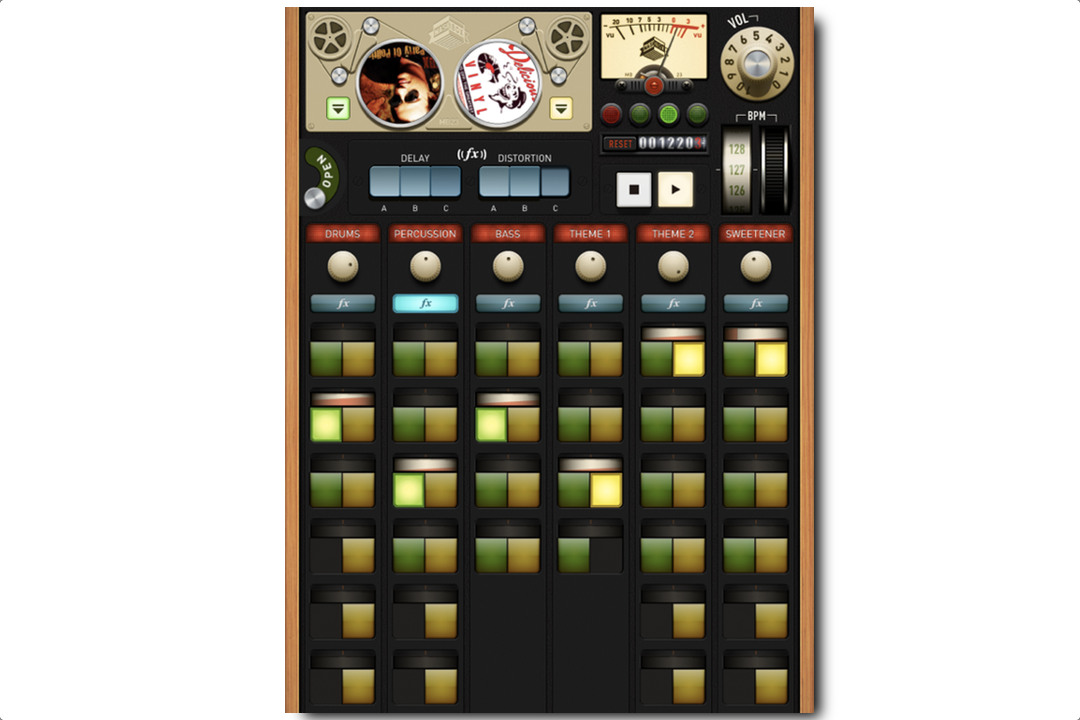
Mashbox is a surprisingly simple workflow, allowing the user to load and mash up loop packs of various popular tracks. The loop packs are divided into six different channels, “Drums”, “Percussion”, “Bass”, “Theme 1″, “Theme 2″, and “Sweetener”. Each channel can have a maximum single loop playing on it at a time, and is controlled with an awkward volume knob at the top of each one. All of the loop triggering is quantized and completely synced, so (for better or for worse your mashups will always sound clean and on-tempo.
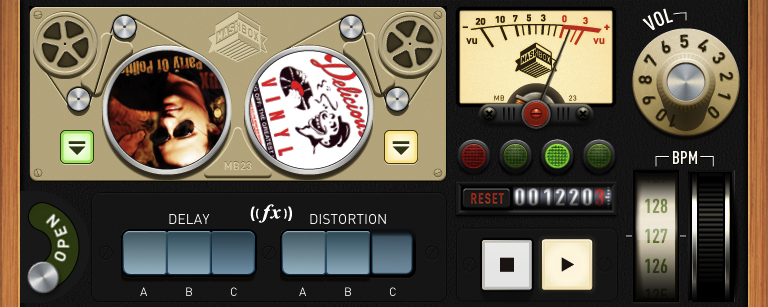
In addition, there is a single FX unit that can be applied to one or many of the channels concurrently – we found that the delay was nice, but the distortion often overpowered a number of the samples and needed a significant volume decrease.
The interface essentially comes off as an extremely stripped-down Ableton Live styled in a cute-but-frustrating analog design. You can’t do anywhere near as much as in a real DJ program or DAW, but it does do what it claims to – building mashups on the fly – very well.
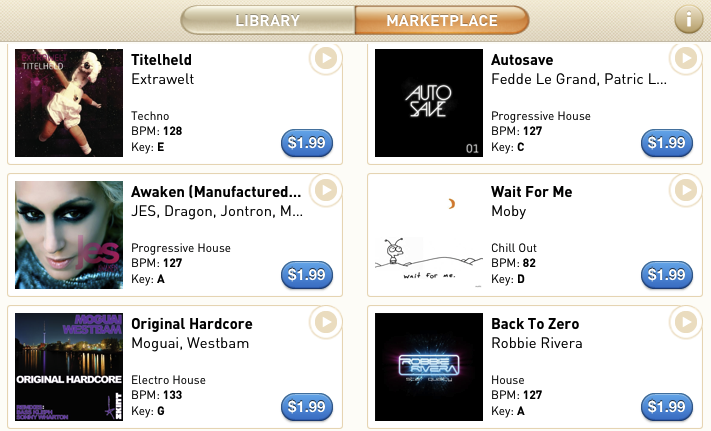
The application is free until December 31st, and then .99¢ after that – but it’s clear that Beatport isn’t expecting to make money off of app sales, but rather of loop pack sales. The application comes with just three tracks to mess around with- “Funky Cold Medina”, “C’Mon”, and “Party of Politics”. Each new pack (there are 12 to purchase at the moment) in the built-in marketplace costs $1.99.
What We Like
- Free!
- Wide Music Variety: while the selection is limited to 12 tracks at the moment, they’re from a number of genres – and Beatport is promising many, many more tracks.
- Analog Interface Design: from the clever downbeat lights to the odometer-style beat counter
- BPM Dial: makes this potentially a tool to mix in with other production work
What Needs Work
- Design Defeats Function: As classic as it looks to have knobs over every channel, knobs suck on a touchscreen. Also, closing the marketplace window requires you to flip an awkward switch.
- Track Player Design: Why put ugly spinning album art in a cool looking analoge interface?
- Limited Playability: Only one clip active per channel may keep the mashups clean, but we get that feeling that we’re all just making the same combinations as everyone else in the world.
- Single FX Unit: We want to use our effects intelligently and diversely, and only one FX unit limits that.
- No follow Actions: It’s really challenging to create a steady progression through the loops.
- iPad only: show some love for the other devices out there!
Even though the UI and general usability of Mashbox leaves a lot to be desired, Beatport’s new app is a very interesting development for the industry. Right now it’s arguably a novelty, but there is clear long-term potential for something bigger.
This is the first time a content provider of this size has attempted to produce a content interaction app in the DJ space. There are many examples of apps that allow you to remix songs or albums, notably Major Lazer and Richie Hawtin’s Plastikman app. However, no one has attempted to bring songs from various sources together in a seamless manner.
If anyone has the artist connections and library to make a stem based mashup tool actually relevant, it’s Beatport. If they can manage to gain traction, build a decent interaction experience, and build a large library of relevant song material, then it will be a very powerful platform. Beatport faces some significant obstacles to success:
- Many artists do not feel comfortable providing stems and parts to their songs fearing countless bad versions and bootlegs may pop up all over the net. In today’s MP3-hype-world, that fear may be counterproductive but it still remains.
- Beatport has a hard enough time getting labels to submit songs with proper tags and artwork. Imagine the trouble in trying to collect stems in a consistent format and then converting them down to a standard that always mixes each stem perfectly together. At $1.99 and 30% to the Apple Store, is it even profitable?
- Is it worth all of the effort to bounce out and create these files when many artists can make more off their 2 track mixes in MP3 form on the old Beatport? Possibly, especially given that the walled garden effect of building this app for Apple’s iPad makes piracy non-existent.
- Do DJs really want to mute and unmute each part? Does the effort required create a result that is better than the sum of its parts? Most Ableton DJs I know use a significantly simpler layout when playing live, so it can easily be understood and mastered. I wonder if DJs really want to remix songs at this level. Let us know below!
Ean’s bottom line: The app has some room for growth but the new format is what we have all been waiting for. The major question we’re wondering- when can everyone else get this content and use it with a great controller?
Let us know what you think about Mashbox in the comments below. Download your own free copy here.
Thursday, 23 June 2011
Yamaha release TNR-i, Tenori-on for iOS
Yamaha have announced the immediate release of their TNR-i app.
The new TNR-i is, as with its parent the Tenori-on, based on a 16 x 16 grid of buttons which are used to sequence and trigger sounds; the horizontal direction relates to time, the vertical pitch. Most other features of the original, such as its interchangeable 16 song patterns and different composition modes, also make it to the TNR-i, although this new incarnation has its own set of benefits. Users can link with up to four other people via a network for simultaneous composition, while those who already own the Tenori-on can also connect via this feature. The video below gives a basic demonstration of the TNR-i.
The new TNR-i is, as with its parent the Tenori-on, based on a 16 x 16 grid of buttons which are used to sequence and trigger sounds; the horizontal direction relates to time, the vertical pitch. Most other features of the original, such as its interchangeable 16 song patterns and different composition modes, also make it to the TNR-i, although this new incarnation has its own set of benefits. Users can link with up to four other people via a network for simultaneous composition, while those who already own the Tenori-on can also connect via this feature. The video below gives a basic demonstration of the TNR-i.
Subscribe to:
Posts (Atom)